
Today, Matt and I were visiting barns on behalf of the Green Mountain Timber Frames team. I am constantly amazed by the creative ingenuity of New England’s early farmers. These brave souls were—and are still—truly a backbone of the beautiful and communal aspects of our local New England culture.
An Ode to Farmers
Having grown up on a working dairy farm, I have witnessed the challenges that face farmers on a daily basis. Thinking of my father, my mother, and my grandfather as they strived to keep a farm running, I pondered the necessity for creativity and tenacity when it comes to getting that hay bailer or tractor running when it is desperately needed. I believe the same principle applied to the ways in which early farmers dealt with their timber frame barns.
Today, as we assessed one particular barn, we discovered some very clever repairs made to the frame over the years. We were inside an incredible 32×52 hand hewn timber frame barn that is badly fatigued and in need of help.
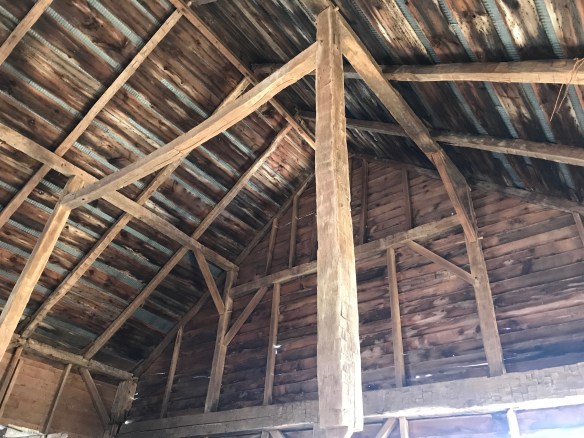
Unfortunately, the barn abutting this one was in much worse shape, and I felt quite deflated and heartbroken to see it.
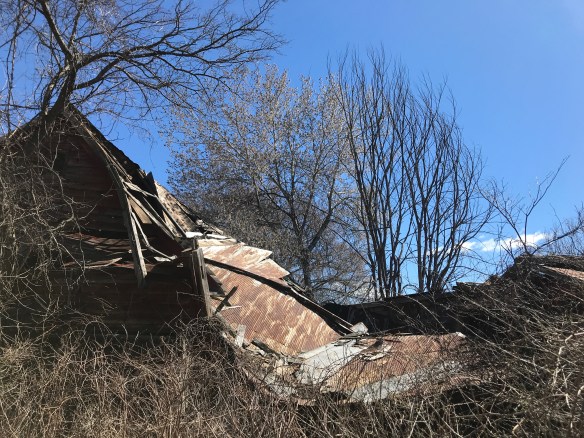
This collapsed building still has a few vintage boards and timbers that can be salvaged.
But let’s return to the happier prospect of the barn we had come to see.
52-Feet of Chesnut Timbers
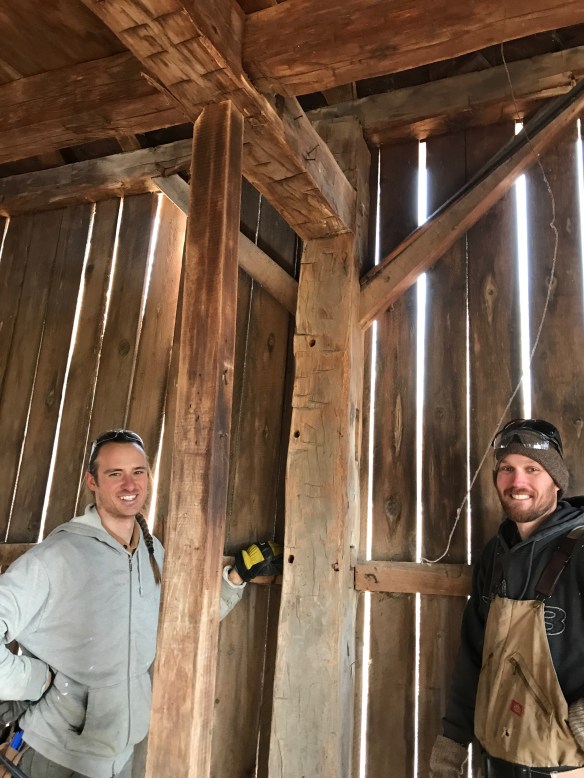
It was built very early, and has many American chestnut timbers. The rafters are hewn, and the posts are massive at 11×11 inches. Of the four timbers that span the length of the building, 3 are an incredible 52-feet of continuous hand hewn chestnut, with the fourth having a scarf joint to join two timbers together.
Imagine that: 52 foot American chestnut timbers that were shaped with a broad axe and an adze- and lots of spirit and grit.
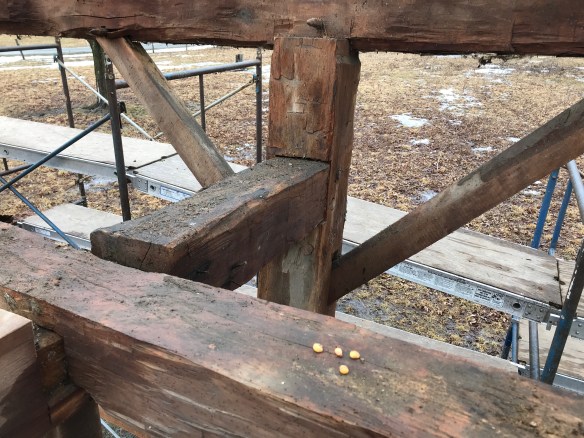
Incredibly, one of the bents is a clear-span 32-foot timber truss. This means it was built strong enough to not need any interior posts, allowing the farmer to move a wagon and animals around inside with ease. In the next photo, you can see the two chestnut timbers that create the truss. They are tied together in the middle with a vertical timber, creating a remarkably strong system.
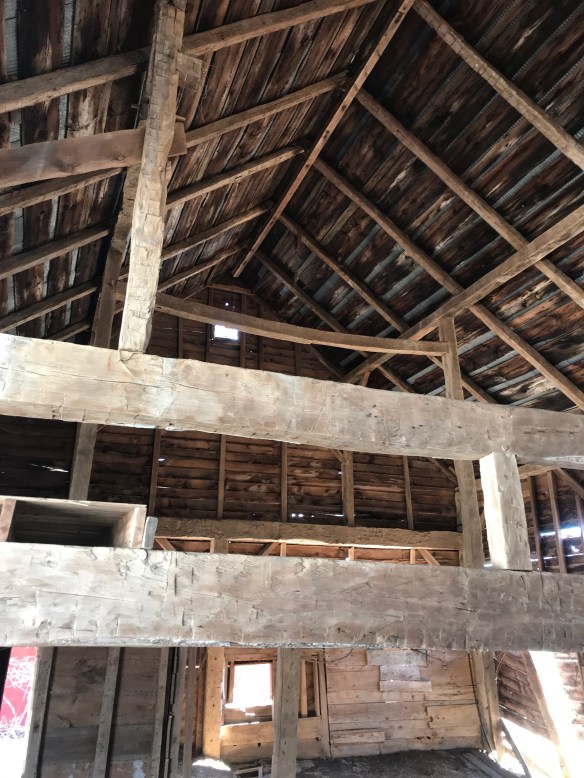
What about the clever repairs?
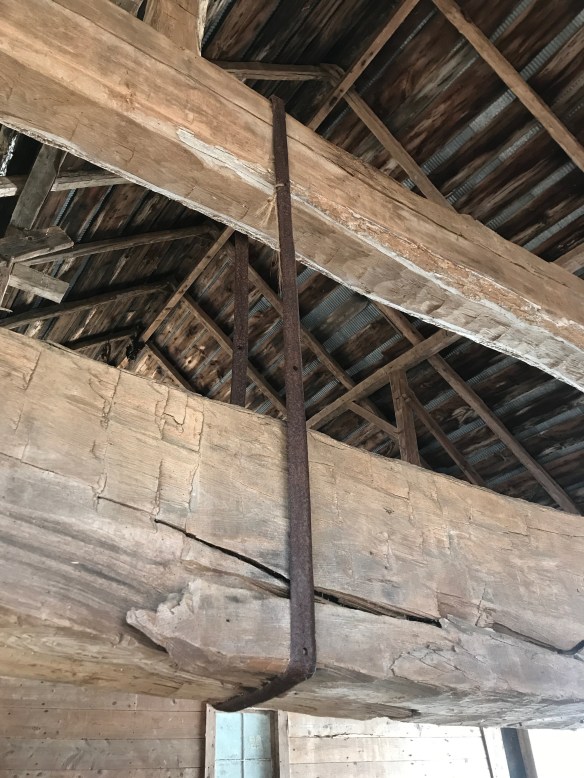
It seems that at some point in the history of this barn’s use, the lower timber, which measures 11 x 18 inches by 32-feet, developed a split. Matt and I were studying the repair that was done in the past, and we realized that it was made using the metal rim of an old wagon wheel!
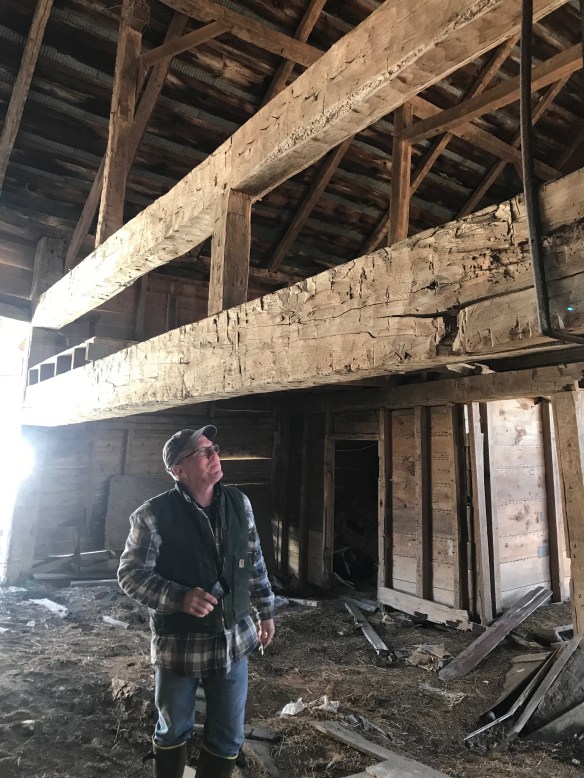
Here is a close-up of the ingenious repair, recycling no doubt a farm implement that’s use had gone by the wayside:
We also discovered a wonderful thing for us modern timber framers to see: a likely mistake made by our mentors who lived two hundred years ago. In a way, it is refreshing to see that even those incredible craftspeople from the past occasionally made an error like we sometimes do!
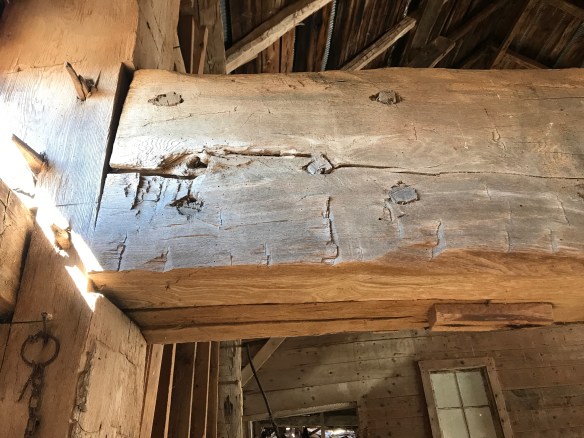
One of the 32-foot timbers did not have a typical tenon. It sure looks like someone cut this timber too short. We have all been there who have cut mortise and tenons time after time. It is a big “whoops” when it involves an 11 x 18 inch by 32-foot American chestnut timber that was cut and hewn by axe and adze!
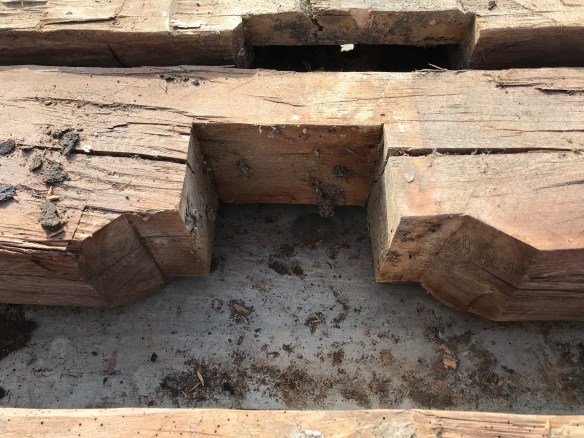
In the next photo, you can see where a spline was added to the end of the girt, essentially adding back the section that was missing. If you look carefully at the underside of this massive timber, you can see where a 2-inch plank was let in, and then pegged thoroughly.
This ingenious repair reminds me of a saying given to me by a wise builder when I was starting out as a framer:
“The sign of a great carpenter is not whether you make mistakes or not; rather, it is about how creative you can be about fixing your mistakes when they happen!”
I am trying to remember what error I had made as a 22-year-old to earn me that old “chestnut” of wisdom. I don’t remember what it was, but I am grateful for the lesson that was imparted to me that day, and I remember it still. Well, the repair in this barn held up well. Approximately 210 years, and holding strong!
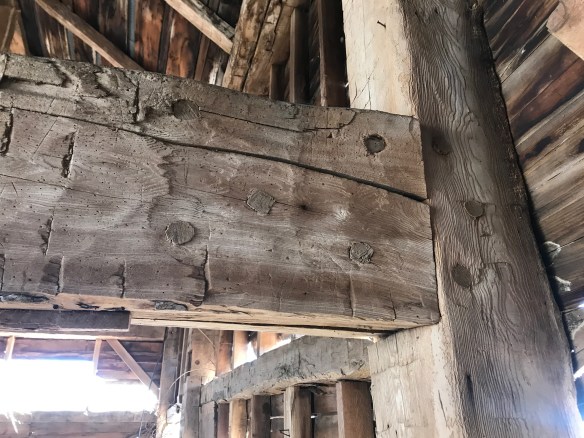
Speaking of holding strong, we saw a real example of the strength of a single oak peg, or trunnion, used in the old days to fasten the timber joinery together without the use of nails. As I mentioned earlier, this barn is struggling, and due to a leak in the roof, one of the 32-foot girts that span the building has rotted completely away.
Incredibly, the 12-foot post that used to be supported by that missing timber is still in the air as part of the queen system supporting the rafters. Here it is:

It is amazing to me how these well-crafted barns can hold together in spite of serious distress! Just one peg. Hm, that seems like a possible metaphor for what each of us humans can do for holding together the values that we treasure in our communities. I will save that musing for later. But think about it- a single one-inch peg holding up that 12-foot hardwood post. Incredible.
Just a couple miles from this grand old barn, there stands another. Unfortunately, the main structure is beyond restoration. But when I climbed into the icy basement, I was amazed by a support for the barn that was added sometime in the first half of the 20th century. Clearly, the floor system had been sagging, and a clever farmer knew just how to form up a support for the beams.
Once again, a derelict symbol of past farming practice was recycled. Just take a look at this:

Old wooden barrels, no doubt leaky or just no longer used, were stacked up with the bottoms cut out. After that, it was as simple as pouring in the concrete! The wood of those barrels is long gone, but their “fingerprints” left no doubt how this impressive pier was created.
Here is to all those who have worked creatively to sustain and stabilize these majestic structures from the past, and also to all in our communities who desire to see our cultural farming heritage preserved for the future!
May those of us dedicated to preserving these structures be as creative, industrious, and as dedicated as those who have come before us.
Interested in one of our old barns for sale?
Give us a holler!
 802.774.8972








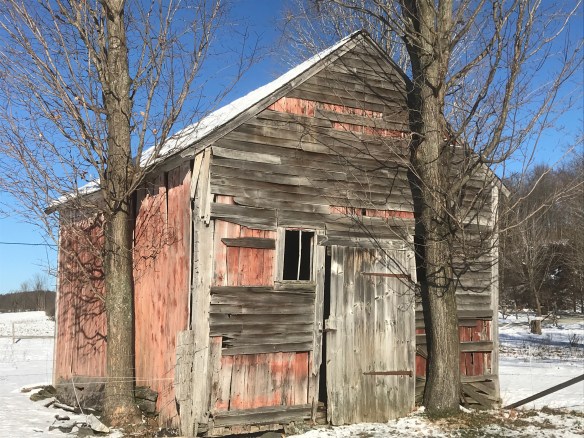
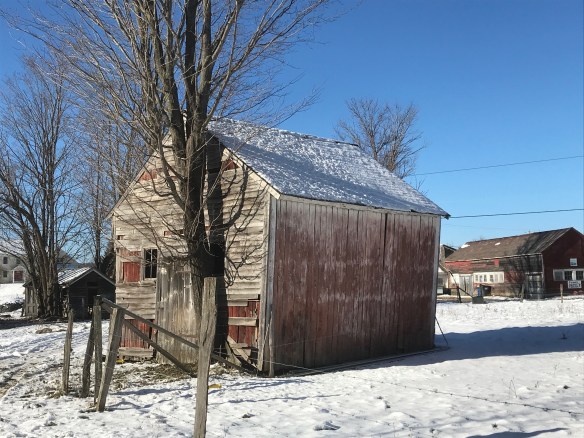








 The barn’s foundation, roof and sills are deteriorated, and would be very difficult and costly to repair in place. We have purchased the barn and now it is in our court to take down the frame, restore it, and find a new home for this majestic and historic building.
 The hay piled inside the barn had been hiding a very interesting feature of this barn. The smallest bay, which is where the animals were kept, had built in wooden gutters for removing manure.
 We made another discovery while opening up the walls of this barn. Between layers of siding, honey bees had built a hive at some point in the past.
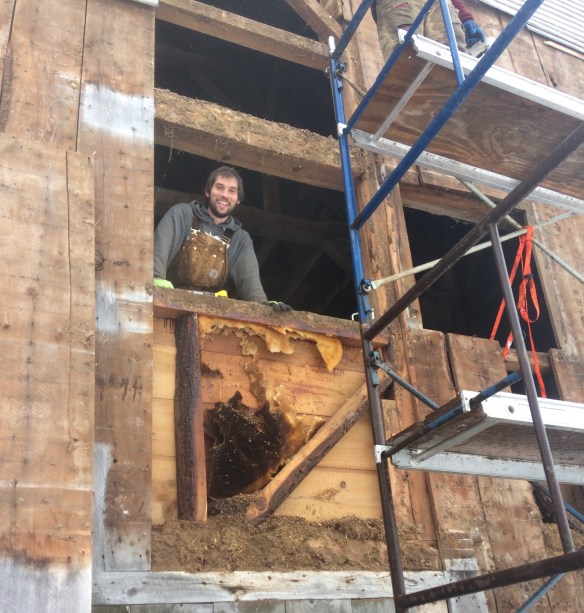 We collected the brittle wax comb, and I am excited to make candles out of it. Once we find a new home for this barn and re-erect it, I can imagine a celebratory meal in the restored frame- lit by the wax of this bee hive.
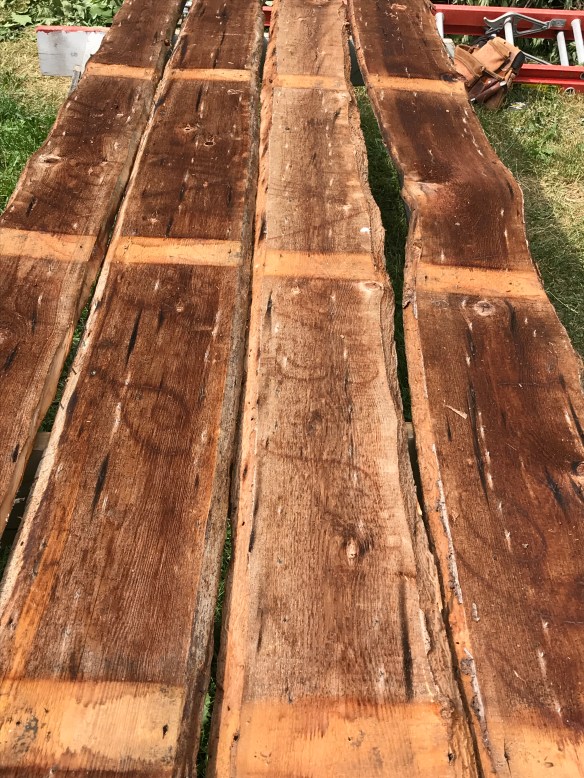
  As we removed the wide hemlock wall boards, we labeled each one so they can be installed back in the same location. Many of the timber boards are over 15 inches wide, and the patina on them is spectacular.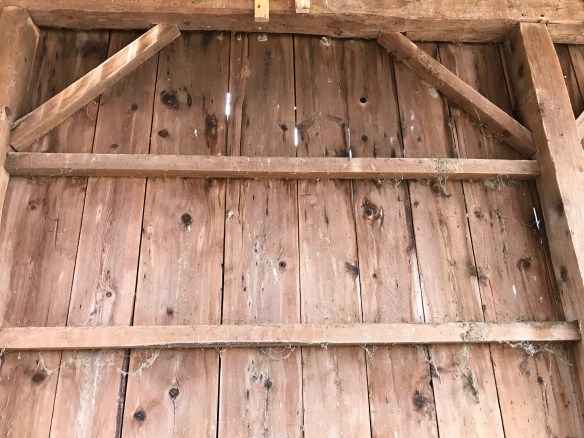
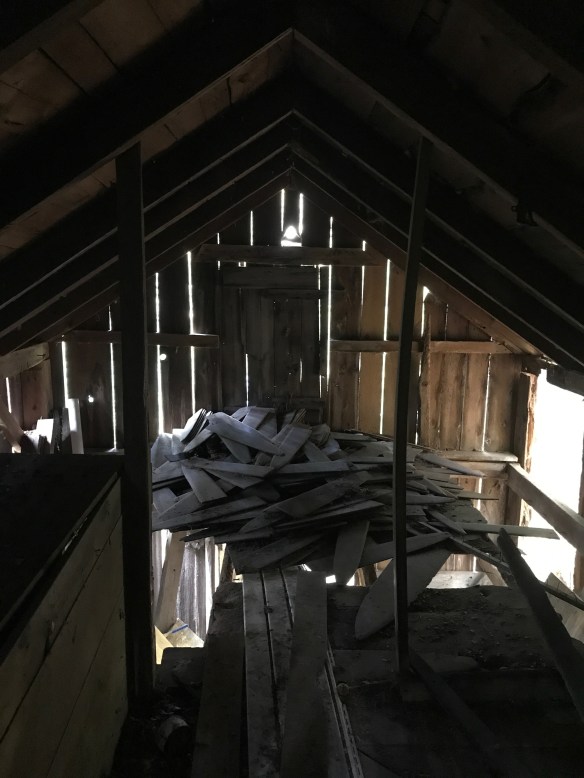
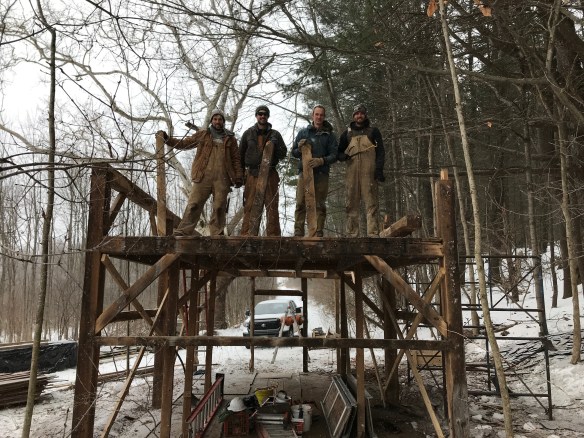
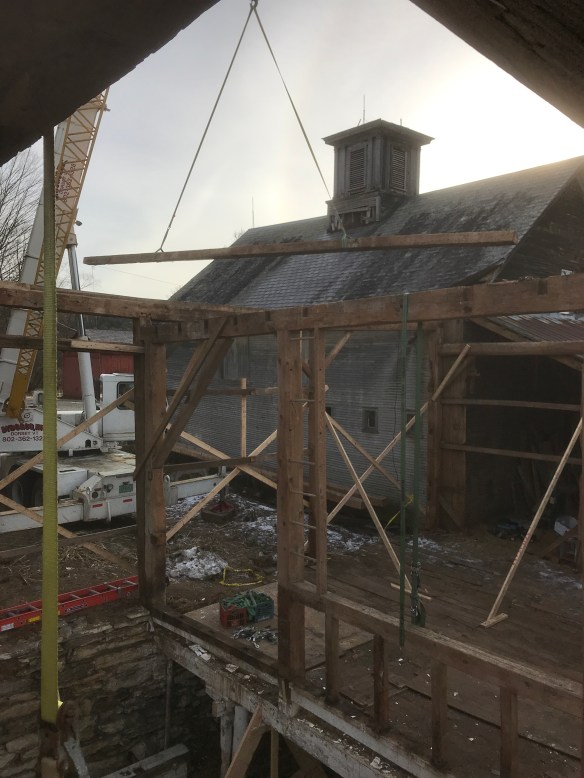
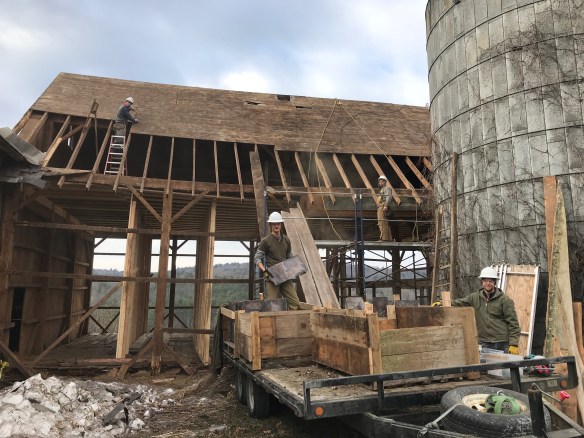 In order to be as safe as possible, we built a temporary second floor in the barn. This allows us to do most of the board and rafter removal from this deck rather than from the top of the roof or from long ladders. This barn is so large that it took fifty sheets of plywood to create this safe work platform!
  The effort building the deck paid off, as we removed and labeled each roof board.
 Let me share a couple more interesting features of this barn:
 A good luck horseshoe was nailed to one side of the door opening.
  It was exciting to get lots of light on the upper queen system. These timbers support the rafters at mid-span, making the roof strong enough to carry the weight of all that slate as well as Vermont’s winter snow. There is a unique and beautiful scarf joint that was used to get the queen plates to span the whole 48 feet.
 While the queen plate is made out of two timbers, the main top plate that creates the eve of the building is not. Incredibly, these hand-hewn timbers are the full length of the barn at 48 feet and 2 inches! Imagine the size of the old-growth tree that was required, as well as the difficulty of getting these beams in place without the use of modern equipment.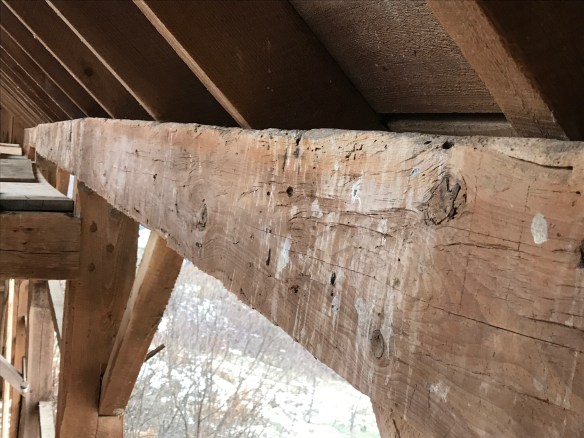
 We had been called because the foundation under a large gunstock timber frame is crumbling, and the property owners would like to see this barn saved and re-homed before it deteriorates further. This barn was worth the long drive from our home base. The posts and timbers are beautiful, and even the braces are hand hewn.
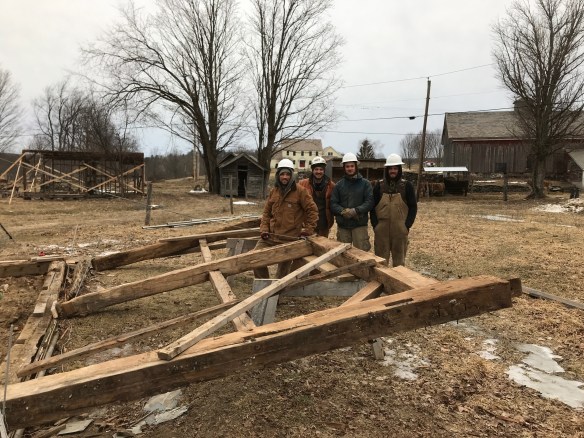
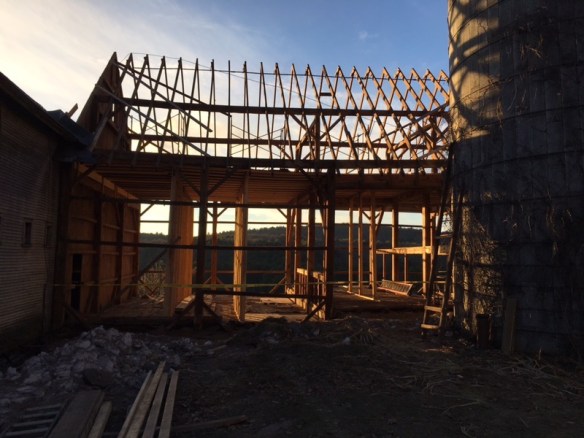
 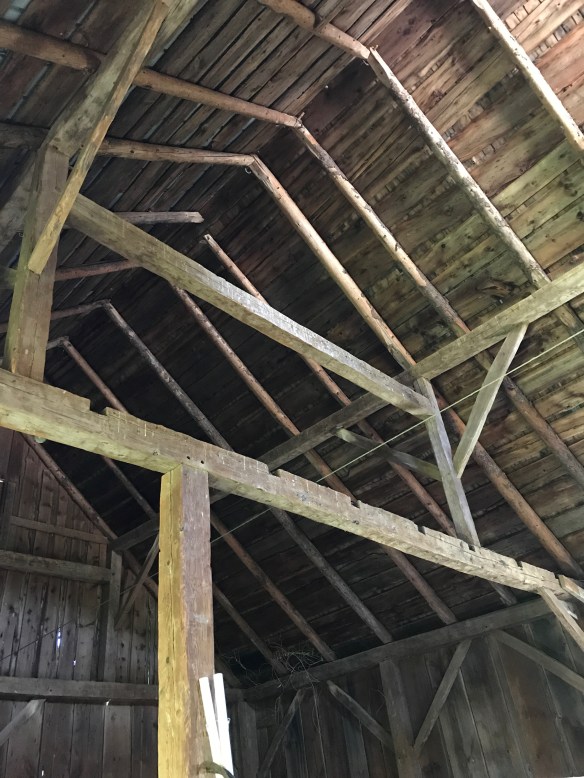 We will be carefully disassembling this beautiful and worthy barn in the coming months, after which we will restore the timber frame. Stay tuned for more information as we get this structure measured, drawn to scale, and listed as an available frame on our webpage.
 There, next to the barn, was a decrepit old silo, with vines growing up the side. It looked like the turret of some old agricultural castle, and I pushed my way through wild grapes and wild cucumber vines to find the opening.
  The roof had collapsed and I could see vegetation reclaiming the interior. The old stone foundation was mossy and I could imagine the excitement of the farm crew many years ago as they laid these rocks in a neat circle to define the storage space for their crops- no doubt in between the daily chores of feeding the animals, tending the fields along the Connecticut River and milking the cows.
 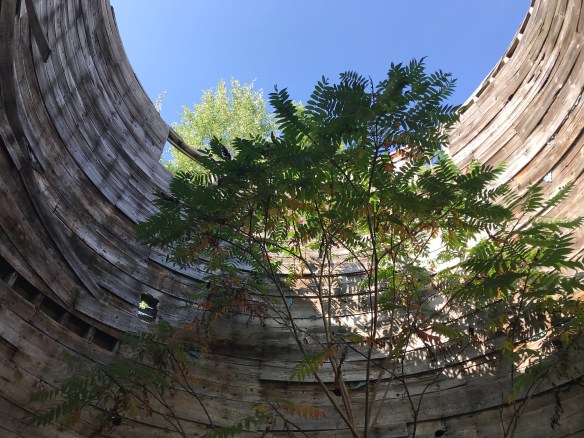 Unlike most of the old wooden silos that have vertical boards held together with steel rings, this one had vertical studs with thin boards bent to match the radius inside and outside. A sumac tree had sprouted, and its upper branches were capturing the afternoon sunlight as I peered in. A single four pane window was in the top of the silo wall, and in the early days this would have let that same sunlight into the interior to illuminate for the farmer how much of the summer’s bounty remained as the winter months progressed. I am so glad we will be catching the large barn before it, too, is reclaimed by vines and trees.
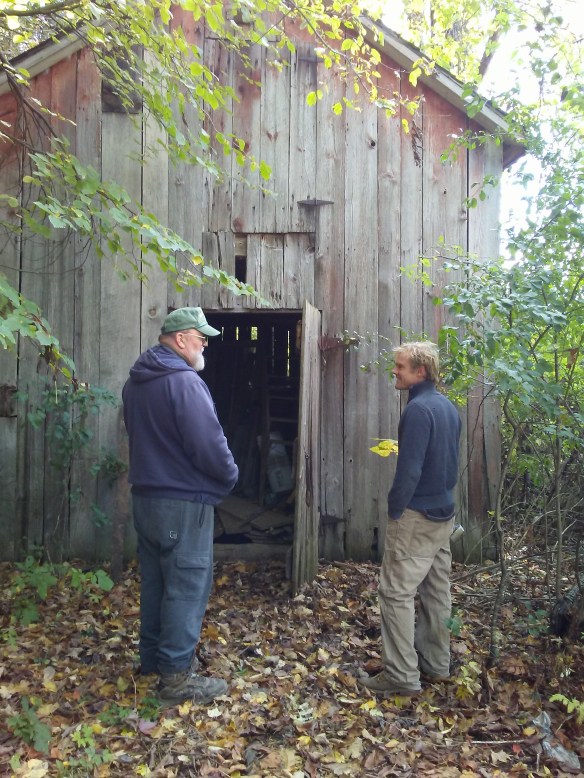
 I asked about the little barn, and was granted permission to explore it. The owners had not been in it for a very long time, and suspected it was nothing that would be of interest or that could be salvaged. I went in for a closer look.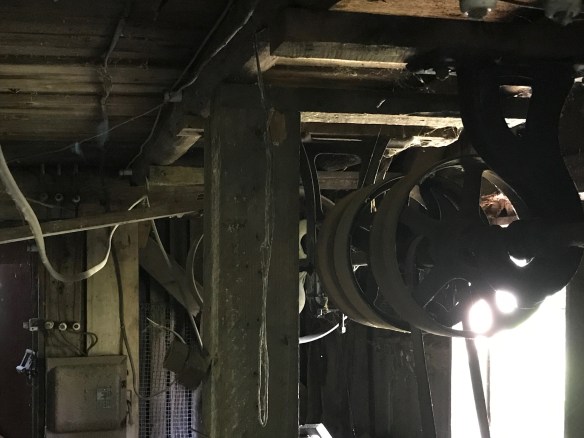
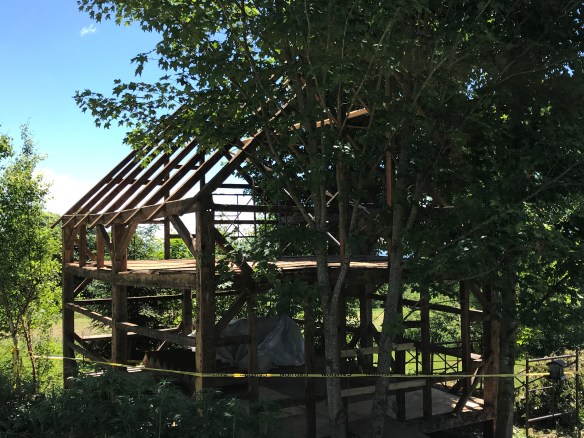
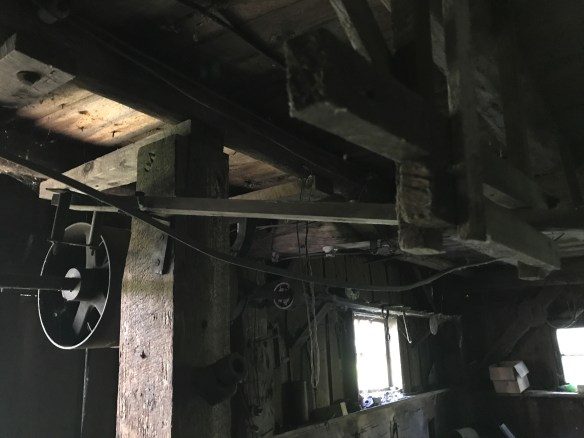 The incredible durability of old-growth timbers was apparent as I inspected the hand-hewn timber frame. In spite of the trees pressing in, the frame is worthy of restoration, and we agreed to purchase this 14×18 foot frame. Once restored and erected on a new foundation, it will make a remarkable cabin with sleeping quarters on the second floor. We will be listing this corn crib on our webpage soon.
 I cannot wait to spend a day inside this barn with our dedicated team doing our best to decipher and document the creative web of belt-driven machines and jigs. We will then begin popping out the hardwood pegs, disassembling the timber frame joinery, and labeling all of the wooden joints. In time, this frame too will have a new home and a continued evolution of usefulness. The constant variable throughout these progressions will be the stout integrity of the structure and its aesthetic beauty.
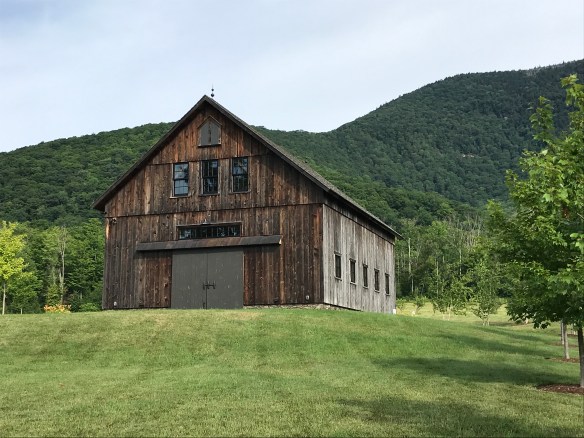
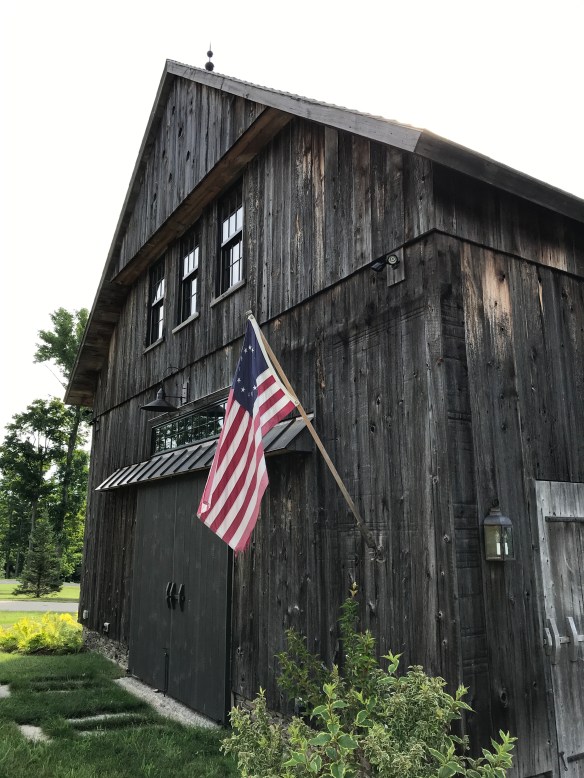
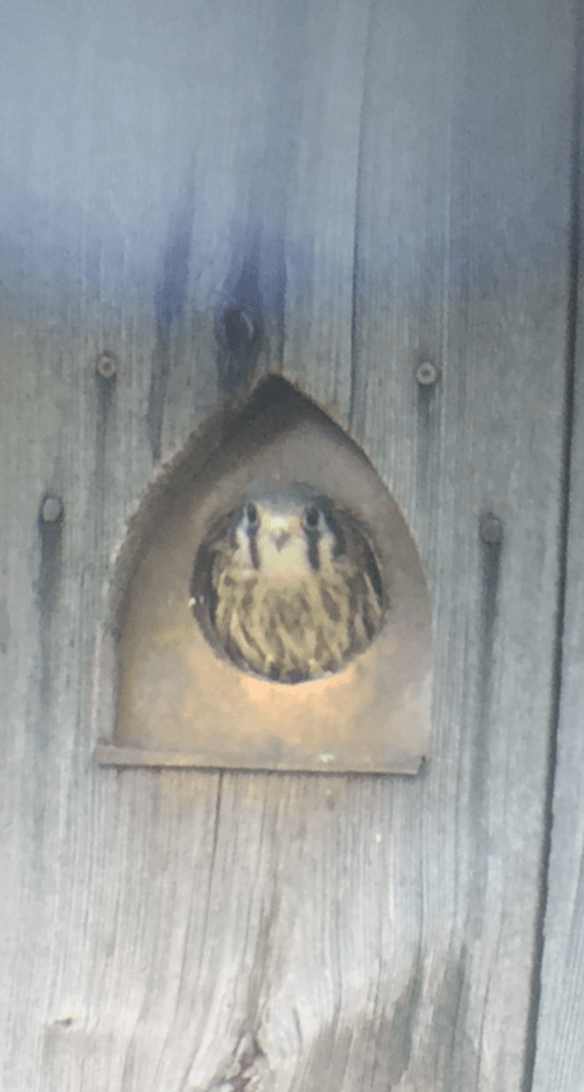
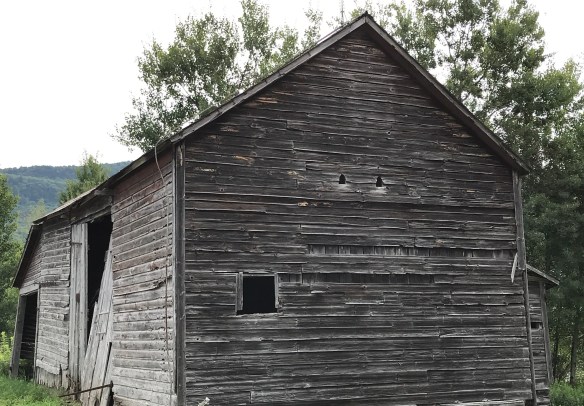 When we sided our barn using vintage boards, we cut six holes in the upper section. Copper flashing was used to keep water from going in. Five of the doors are faux, and the sixth has a hole that leads into a nesting box.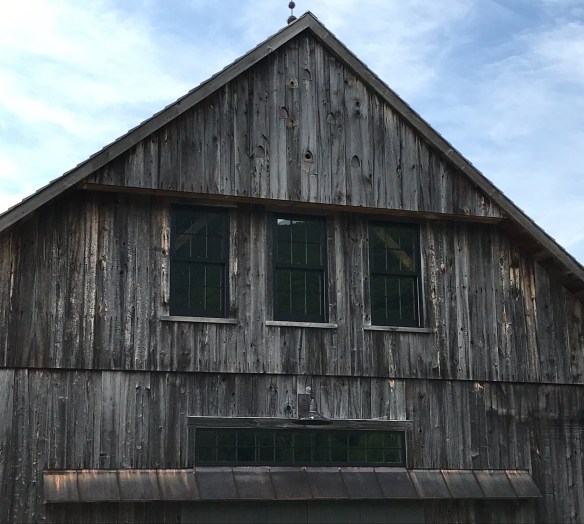








 A Blog about Old Barns ~ from Green Mountain Timber Frames